
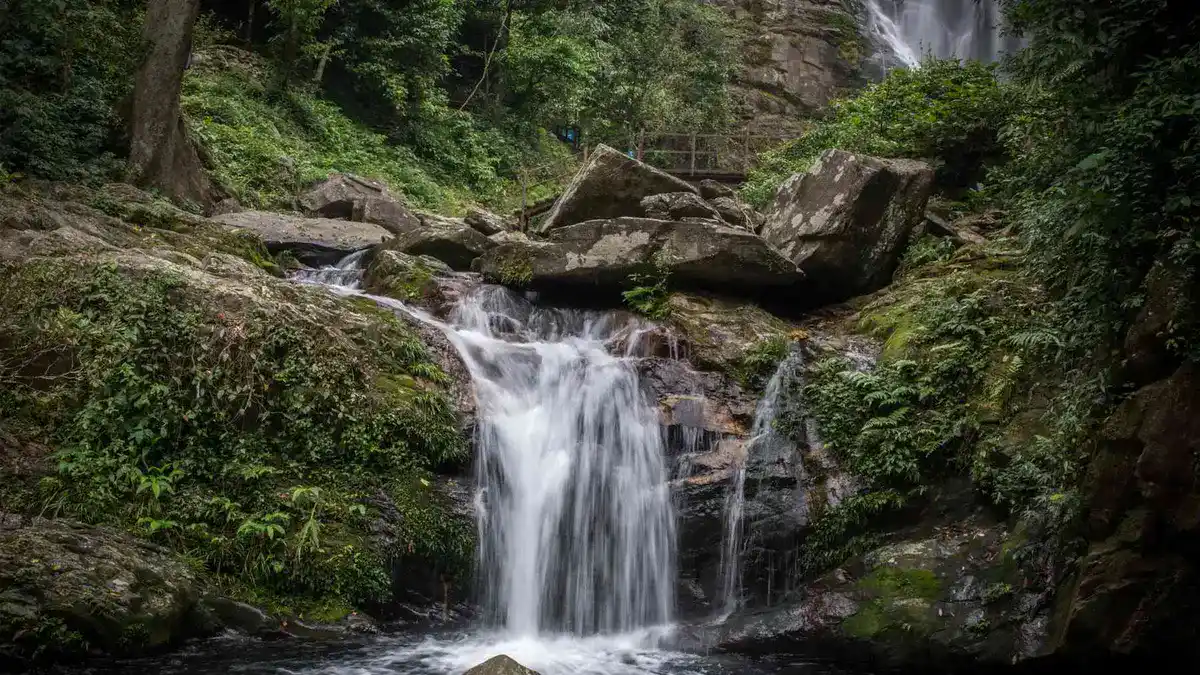
Vietnam National Parks – Pu Mat National Park lies in Nghe An Province, in Vietnam’s North‑Central region, covering a core protected area of approximately 94,804 hectares, with additional buffer zones that together contribute to a larger conservation landscape.
The name “Pù Mát,” derived from the local Thai language, means “high slope” — a reference to its mountainous terrain.
The park spans the districts of Anh Son, Con Cuong, and Tương Dương, and its topography includes rugged mountains, dense tropical and subtropical forests, karst formations, river valleys, and diverse aquatic systems.
Since its official designation as national park in 2001 — moving from its prior status as a nature reserve — Pu Mat has become central to conservation initiatives in the region.
Moreover, as the core zone of Western Nghe An Biosphere Reserve, recognized by UNESCO since 2007, Pù Mát holds international conservation value.
Biodiversity and Ecosystems
Pu Mat National Park is acknowledged as one of Vietnam’s most important biodiversity hotspots. Its rich natural heritage spans flora, fauna, and varied ecosystems deeply tied to the Annamite Mountains.
Flora
- Surveys have confirmed about 2,461 – 2,500 plant species in Pù Mát, distributed across hundreds of genera and plant families.
- The most extensive vegetation type is lowland evergreen forest, complemented by mixed evergreen broadleaf forests, subtropical moist coniferous forests at higher elevations, and patches of secondary or recovered forest.
- Among these flora, a notable number are categorized as rare or endangered under national conservation lists, highlighting the park’s importance as a genetic reservoir.
Fauna & Rare Wildlife
Pu Mat is globally important for mammal conservation and hosts many rare, endemic, or threatened species:
- Species endemic to Indochina found here include Saola (often nicknamed “Asian Unicorn”), Truong Son Muntjac, Annamite Striped Rabbit, and primates such as Northern White-cheeked Gibbon and Red-shanked Douc.
- The park is also home to larger mammals such as Asian elephants, tigers, and other globally threatened species — underscoring its value for large‑mammal conservation.
- Birdlife is abundant and diverse, with hundreds of bird species recorded. Pù Mát is considered an Important Bird Area, reflecting its significance for avian biodiversity.
- The variety of habitats — from lowland forests to highland zones — supports reptiles, amphibians, insects, and freshwater aquatic species as well, many of which contribute to the park’s endemic and rare species richness.
Conservation Significance Pu Mat National Park
Pu Mat National Park plays a vital role in ecosystems, including protecting rare and endangered flora and fauna.
Critical Protection for Endangered Species
Given its role as one of the last intact blocks of natural forest in northern Vietnam, Pu Mat provides essential refuge for rare and threatened species. The recorded population of northern white-cheeked gibbons here is among the largest known in Vietnam.
With its endemic species — such as Saola, whose global population is extremely limited — Pu Mat plays a vital role in preserving genetic diversity and preventing extinction.
Integral Part of a Biosphere Reserve
As the core area of the Western Nghe An Biosphere Reserve, Pu Mat is part of a broader landscape-scale conservation strategy recognized internationally, combining habitat preservation, ecological research, and sustainable development.
Ecosystem Services & Forest Integrity
Pu Mat’s forests contribute to climate regulation, watershed stability, soil conservation, and maintenance of ecological balance. The large contiguous forest area preserves ecosystem integrity, essential for long-term biodiversity maintenance.
Cultural and Ethnobiological Aspects
Beyond natural heritage, Pu Mat is home to several ethnic minority groups — including Thai, Đan Lai, and others — who have lived in and around the forest for generations. Their traditional knowledge, especially in forest use and medicinal plants, adds a valuable human dimension to conservation.
The intertwining of cultural heritage and natural forest landscapes makes Pù Mát not only a site of ecological importance, but also of ethnobiological and sociocultural value.
Landscapes & Natural Features

Pu Mat’s physical geography offers a variety of landscapes:
- Mountain ranges and slopes — reflecting its name meaning “high slope.”
- Forested valleys, karst formations, and river systems — including the scenic Giăng River which traverses the park and carves through rugged forested landscapes.
- Waterfalls and pristine streams — for example Khe Kem Waterfall, described as a 150‑meter cascade often likened to a “white silk ribbon” flowing through the forest canopy.
- Remnant primary forest areas, including ancient-growth stands with large canopy trees, some reaching 50 meters high — offering refuge for old‑growth species and complex forest dynamics.
Threats & Challenges Pu Mat National Park
While Pu Mat remains one of Vietnam’s strongestholds for biodiversity, several threats and challenges persist:
- Habitat degradation pressures — historical shifting cultivation and logging threaten forest integrity, especially in buffer zones or peripheral areas.
- Illegal hunting and wildlife trafficking — as with many biodiverse regions, vulnerable species such as Saola, primates, and large mammals are at risk without strict protection and community engagement.
- Balancing conservation and community livelihoods — local ethnic communities rely on forest resources for subsistence, so conservation strategies must integrate sustainable development and community participation to succeed long‑term.
Importance for Conservation, Research, and Education
Pu Mat National Park’s value extends across multiple domains:
- Conservation hotspot for rare and endemic species — critical for national and global biodiversity preservation.
- Natural laboratory for ecological, botanical, zoological, and ethnobiological research, offering insights into tropical forest dynamics, species adaptation, and human–environment interactions.
- Model for integrated conservation — combining strict protection, sustainable community livelihoods, and biosphere‑reserve governance under international recognition.
- Educational value — raising awareness about forest conservation, threatened species, and the interdependence of natural and cultural heritage.
Leave a Reply